
“Where there is anger, there is always pain underneath.” ~ Eckhart Tolle, The Power of Now (Page 40)
Archives



“If you no longer want to create pain for yourself and others, if you no longer want to add to the residue of past pain that still lives on in you, then don’t create any more time, or at least no more than is necessary to deal with the practical aspects of your life. How to stop creating time? Realize deeply that the present moment is all you ever have. Make the Now the primary focus of your life. Whereas before you dwelt in time and paid brief visits to the Now, have your dwelling place in the Now and pay brief visits to past and future when required to deal with the practical aspects of your life situation. Always say ‘yes’ to the present moment. What could be more futile, more insane, than to create inner resistance to something that already is? What could be more insane than to oppose life itself, which is now and always now? Surrender to what is. Say ‘yes’ to life—and see how life suddenly starts working for you rather than against you.” ~ Eckhart Tolle, The Power of Now (Page 35)
“Glimpses of love and joy or brief moments of deep peace are possible whenever a gap occurs in the stream of thought. For most people, such gaps happen rarely and only accidentally, in moments when the mind is rendered ‘speechless,’ sometimes triggered by great beauty, extreme physical exertion, or even great danger. Suddenly, there is inner stillness. And within that stillness there is a subtle but intense joy, there is love, there is peace.” ~ Eckhart Tolle, The Power of Now (Page 29)
“The harder the mind struggles to get rid of the pain, the greater the pain. The mind can never find the solution, nor can it afford to allow you to find the solution, because it is itself an intrinsic part of the ‘problem.’ Imagine a chief of police trying to find an arsonist when the arsonist is the chief of police. You will not be free of that pain until you cease to derive your sense of self from identification with the mind, which is to say from ego.” ~ Eckhart Tolle, The Power of Now (Page 28)
“If you really want to know your mind, the body will always give you a truthful reflection, so look at the emotion, or rather feel it in your body. If there is an apparent conflict between them, the thought will be the lie, the emotion will be the truth. Not the ultimate truth of who you are, but the relative truth of your state of mind at that time.” ~ Eckhart Tolle, The Power of Now (Page 26)
“If you cannot feel your emotions, if you are cut off from them, you will eventually experience them on a purely physical level, as a physical problem or symptom.” ~ Eckhart Tolle, The Power of Now (Page 25)
“The mind is a superb instrument if used rightly. Used wrongly, however, it becomes very destructive. To put it more accurately, it is not so much that you use your mind wrongly—you usually don’t use it at all. It uses you. This is the disease. You believe that you are your mind. This is the delusion. The instrument has taken you over.” ~ Eckhart Tolle, The Power of Now (Page 16)
The Power of Now [Book]

Book Overview: To make the journey into The Power of Now you need to leave your analytical mind and its false created self, the ego, behind. Access to the Now is everywhere – in the body, the silence, and the space all around you. These are the keys to enter a state of inner peace. They can be used to bring you into the Now, the present moment, where problems do not exist. It is here you find your joy and are able to embrace your true self. It is here you discover that you are already complete and perfect. Although the journey is challenging, Eckhart Tolle offers simple language in a question and answer format. The words themselves are the signposts to guide you on your journey. There are new discoveries to be made along the way: you are not your mind, you can find your way out of psychological pain, authentic human power is found by surrendering to the Now. When you become fully present and accepting of what is, you open yourself to the transforming experience of The Power of Now.
Buy from Amazon! Listen on Audible!
Not enough time to read/listen to the whole book? Check out the 16 minute Blinkist version of The Power of Now and get the key insights here for free.
Post(s) Inspired by this Book:
- 32 Deep and Insightful Eckhart Tolle Quotes from The Power of Now
- Eckhart Tolle Quote on Joy and How Your Frequent Desire To Travel Might Be Limiting The Joy You Feel (Beyond the Quote 294/365)
- Eckhart Tolle Quote on Understanding Who You Are and How You Might Best Influence Others (Beyond the Quote 257/365)
- Eckhart Tolle Quote on Love and How Love Isn’t Selective or Exclusive (Beyond the Quote 170/365)
- Eckhart Tolle Quote on Taking Responsibility and Making the Present Moment Your Ally (Beyond the Quote 82/365)
- Eckhart Tolle Quote on Finding The Life Underneath Your Problems (Beyond the Quote 53/365)
- Eckhart Tolle Quote on Monitoring Your Mental-Emotional State To Keep Your Inside Right (Beyond the Quote 38/365)
- Goals Should Increase Present Joy—Not Move It Further Into the Future (Beyond the Quote 2/365)


18 Powerful Quotes from Extreme Ownership That Will Help You Lead and Win
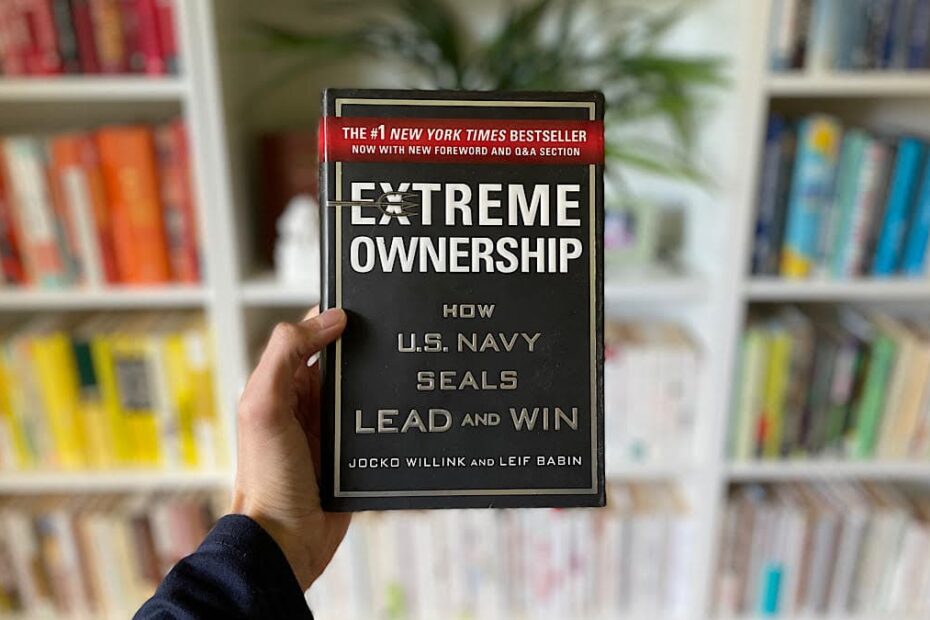
Excerpt: Jocko Willink and Leif Babin know how to lead a team to victory. Our 18 quotes from Extreme Ownership will help you better lead and win too.
Read More »18 Powerful Quotes from Extreme Ownership That Will Help You Lead and Win
“When you’re too embarrassed to ask for help, that’s a little knock at your door saying, ‘You’re insecure!'” ~ Jocko Willink, Extreme Ownership (Page 308)