
“People come to me, they always say, ‘The other is not loving me.’ Nobody comes and says, ‘I am not loving the other.’ Love has become a demand: ‘The other is not loving me.’ Forget about the other! Love is such a beautiful phenomenon, if you love you will enjoy. And the more you love, the more you become lovable. The less you love and the more you demand that other should love you, the less and less you are lovable, the more and more you become closed, confined to your ego.”
Osho, Courage (Page 67)
Archives
“Ordinary people love only when their conditions are fulfilled. They say, ‘You should be like this, only then will I love.’ A mother says to the child, ‘I’ll love you only if you behave.’ A wife says to the husband, ‘You have to be this way, only then can I love you.’ Everybody creates conditions; love disappears. Love is an infinite sky! You cannot force it into narrow spaces, conditioned, limited. If you bring fresh air into your house and close it off from everywhere—all the windows closed, all the doors closed—soon it becomes stale. Whenever love happens it is a part of freedom; then soon you bring that fresh air into your house and everything goes stale; dirty.”
Osho, Courage (Page 66)
“Whenever you have been in love with someone, even for a single moment, was there any fear? It has never been found in any relationship where, if even for a single moment, two persons are in deep love and a meeting happens, they are tuned to each other—in that moment fear has never been found. Just as if the light is on and darkness has not been found—there is the secret key: love more.”
Osho, Courage (Page 64)
“Fear is nothing but absence of love. Do something with love, forget about fear. If you love well, fear disappears. If you love deeply, fear is not found.”
Osho, Courage (Page 64)
How Heavy Is This Glass Of Water? A Short Story About Stress and Compartmentalizing

Excerpt: A psychologist walks into a room of students and asks how heavy her glass of water is? The answer might surprise you…
Read More »How Heavy Is This Glass Of Water? A Short Story About Stress and Compartmentalizing
Osho Quote on Bliss and How Effort is Required for Higher States of Mind
“To me, to be blissful is the greatest courage. To be miserable is very cowardly. In fact to be miserable, nothing is needed. Any coward can do it, any fool can do it. Everybody is capable of being miserable, but to be blissful, great courage is needed—it is an uphill task.”
Osho, Courage (Page 60)
Beyond the Quote (319/365)
In our entire history we have never been more comfortable, more connected, and more safe than we are today and yet, happiness seems to be as far away as it ever has been. Why is that? Shouldn’t the technological advances, ease of access, and revolutions in connection increase our levels of happiness exponentially—or at least place it significantly closer? Intuitively speaking, it feels like they should, right? What gives?
Read More »Osho Quote on Bliss and How Effort is Required for Higher States of Mind“If it were easy then everyone else would find it easy as well. Which would make it awfully difficult to do important work, work that stands out, work that people would go out of their way to find. When difficulties arise, it might very well be good news. Because those difficulties may dissuade all the people who aren’t as dedicated as you are. It pays to seek out the hard parts.”
Seth Godin, Blog
“You cannot bring the new in your life; the new comes. You can either accept it or reject it. If you reject it you remain a stone, closed and dead. If you receive it you become a flower, you start opening… and in that opening is celebration.”
Osho, Courage (Page 56)
“Life can only be lived dangerously—there is no other way to live it. It is only through danger that life attains to maturity, growth. One needs to be an adventurer, always ready to risk the known for the unknown. And once one has tasted the joys of freedom and fearlessness, one never repents because then one knows what it means to live at the optimum. Then one knows what it means to burn your life’s torch from both ends together. And even a single moment of that intensity is more gratifying than the whole eternity of mediocre living.”
Osho, Courage (Page 51)
“To grow to your destiny needs great courage, it needs fearlessness. People who are full of fear cannot move beyond the known. The known gives a kind of comfort, security, safety because it is known. One is perfectly aware, one knows how to deal with it. One can remain almost asleep and go on dealing with it—there is no need to be awake; that’s the convenience with the known.”
Osho, Courage (Page 50)
“If a man knows what peace is, and what mind is, he cannot write a book entitled Peace of Mind, because mind is the cause of all unpeace, all restlessness. Peace is when there is no mind.”
Osho, Courage (Page 45)
James Clear Quote on Learning and How Reading and Reflecting Hold the Keys To Knowledge
“Reading can teach you the best of what others already know. Reflection can teach you the best of what only you can know.”
James Clear
Beyond the Quote (318/365)
And if you’re not doing either, where is it that everything you know is coming from? From social media? From click-bait websites? From news conglomerates? Or maybe from friends and family members? But, where then are they getting their knowledge from? From those same sources? The question you have to ask yourself is, how does the quality of this information compare to the quality of the information that might be obtained from reading and reflecting? I suspect that it may not only be substantially below in quality, but of little to no quality at all. I suspect that it’s a no comparison.
Read More »James Clear Quote on Learning and How Reading and Reflecting Hold the Keys To Knowledge23 Ryan Holiday Quotes from Ego is the Enemy on Success, Humility, and Work Ethic
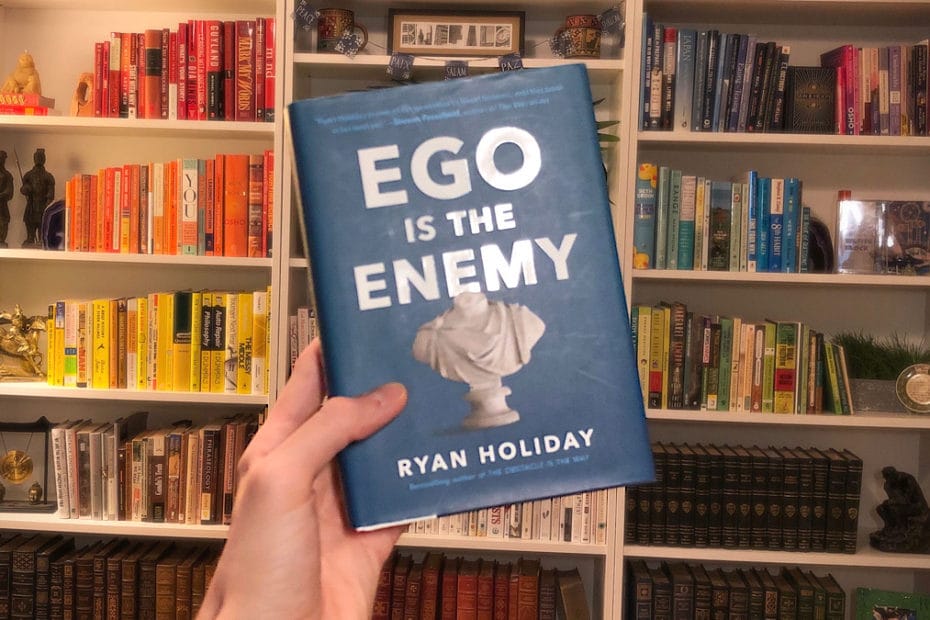
Excerpt: Your ego is holding you back from realizing your full potential in life. Read our 23 quotes from Ego is the Enemy to find out how.
Read More »23 Ryan Holiday Quotes from Ego is the Enemy on Success, Humility, and Work Ethic

Tony Robbins Quote on Staying Committed to Decisions, But Flexible in Approach

“Stay committed to your decisions, but stay flexible in your approach.”
Tony Robbins
Beyond the Quote (316/365)
This young man was told he wouldn’t be able to attend his Martial Arts tournament because he was exposed to someone who tested positive for COVID-19. He was told he would be quarantining at home for 2 weeks instead. But, rather than miss the tournament altogether, the team who orchestrated the tournament offered him and his family a virtual option instead. The family agreed.
Read More »Tony Robbins Quote on Staying Committed to Decisions, But Flexible in Approach“In India it is common wisdom that the world is like a waiting room in a railway station; it is not your house. You are not going to remain in the waiting room forever. Nothing in the waiting room belongs to you—the furniture, the paintings on the wall… You use them—you see the painting, you sit on the chair, you rest on the bed—but nothing belongs to you. You are just here for a few minutes, or for a few hours at the most, then you will be gone.”
Osho, Courage (Page 34)