
“Were you to live three thousand years, or even a countless multiple of that, keep in mind that no one ever loses a life other than the one they are living, and no one ever lives a life other than the one they are losing. The longest and the shortest life, then, amount to the same, for the present moment lasts the same for all and is all anyone possesses. No one can lose either the past or the future, for how can someone be deprived of what’s not theirs?”
Marcus Aurelius, Meditations, via The Daily Stoic (Page 85)
Archives
10 Stephen Grosz Quotes From The Examined Life on Pain, Change, and Loss
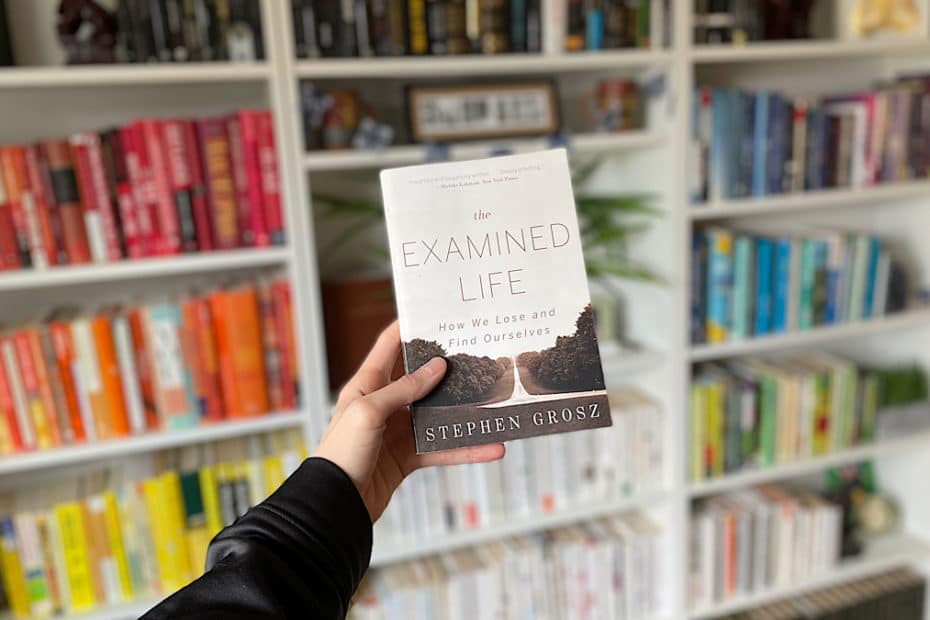
Excerpt: Stephen Grosz has been a psychoanalyst for 25+ years. These quotes from The Examined Life give you access to 50,000+ hours of his distilled insight.
Read More »10 Stephen Grosz Quotes From The Examined Life on Pain, Change, and Loss
“Self-deception, delusions of grandeur—these aren’t just annoying personality traits. Ego is more than just off-putting and obnoxious. Instead, it’s the sworn enemy of our ability to learn and grow.”
Ryan Holiday, The Daily Stoic (Page 84)
“Go with the pain, let it take you… Open your palms and your body to the pain. It comes in waves like a tide, and you must be open as a vessel lying on the beach, letting it fill you up and then, retreating, leaving you empty and clear… With a deep breath—it has to be as deep as the pain—one reaches a kind of inner freedom from pain, as though the pain were not yours but your body’s. The spirit lays the body on the alter.”
Anne Morrow Lindbergh, War Within And Without, via Sunbeams (Page 57)
“I remembered one morning when I discovered a cocoon in the bark of a tree, just as the butterfly was making a hole in its case and preparing to come out. I waited a while, but it was too long appearing and I was impatient. I bent over it and breathed on it to warm it. I warmed it as quickly as I could and the miracle began to happen before my eyes, faster than life. The case opened, the butterfly started slowly crawling out, and I shall never forget my horror when I saw how its wings were folded back and crumpled; the wretched butterfly tried with its whole trembling body to unfold them. Bending over it, I tried to help it with my breath. In vain. It needed to be hatched out patiently and the unfolding of the wings needed to be a gradual process in the sun. Now it was too late. My breath had forced the butterfly to appear, all crumpled, before its time. It struggled desperately and, a few seconds later, died in the palm of my hand. That little body is, I do believe, the greatest weight I have on my conscience. For I realize today that it is a mortal sin to violate the greatest laws of nature. We should not hurry, we should not be impatient, but we should confidently obey the eternal rhythm.”
Nikos Kazantzakis, Zorba The Greek, via Sunbeams (Page 57) (Read Matt’s Blog On This Quote)
“Part of the reason we fight against the things that happen is that we’re so focused on our plan that we forget that there might be a bigger plan we don’t know about. Is it not the case that plenty of times something we thought was a disaster turned out to be, with the passage of time, a lucky break? We also forget that we’re not the only people who matter and that our loss might be someone else’s gain.”
Ryan Holiday, The Daily Stoic (Page 83)
“[Closure] is the false hope that we can deaden our living grief.”
Stephen Grosz, The Examined Life (Page 210)
“My experience is that closure is an extraordinarily compelling fantasy of mourning. It is the fiction that we can love, lose, suffer and then do something to permanently end our sorrow. We want to believe we can reach closure because grief can surprise and disorder us—even years after our loss.”
Stephen Grosz, The Examined Life (Page 209)
“Psychoanalysts are fond of pointing out that the past is alive in the present. But the future is alive in the present too. The future is not some place we’re going to, but an idea in our mind now. It is something we’re creating, that in turn creates us. The future is a fantasy that shapes our present.”
Stephen Grosz, The Examined Life (Page 157)
“There is no use in one person attempting to tell another what the meaning of life is. It involves too intimate an awareness. A major part of the meaning of life is contained in the very discovering of it. It is an ongoing experience of growth that involves a deepening contact with reality. To speak as though it were an objective knowledge, like the date of the war of 1812, misses the point altogether. The meaning of life is indeed objective when it is reached, but the way to it is by a path of subjectivities… The meaning of life cannot be told; it has to happen to a person.”
Ira Progoff, via Sunbeams (Page 56)
“The unrestricted person, who has in hand what they will in all events, is free. But anyone who can be restricted, coerced, or pushed into something against what they will is a slave.”
Epictetus, Discourses, via The Daily Stoic (Page 81)
“We can sometimes exploit a disaster to block internal change. Like Elizabeth, we can take on a catastrophe to stop ourselves feeling and thinking—and to avoid responsibility for our own intimate acts of destruction.”
Stephen Grosz, The Examined Life (Page 145)
“Sometimes we might try to assume responsibility for a major disaster in order to avoid responsibility for our own destructive behaviour.”
Stephen Grosz, The Examined Life (Page 143)
“‘Success has ruined many a man,’ Benjamin Franklin once said. This is true enough, but what Franklin didn’t mention is that we often work the ruin upon ourselves.”
Stephen Grosz, The Examined Life (Page 132)
“Problems are not problems at all, but results that are dissatisfying.”
Jerry Gillies, via Sunbeams (Page 55)