
“The happiest, most passionate employees are not those who followed their passion into a position, but instead those who have been around long enough to become good at what they do. On reflection, this makes sense. If you have many years’ experience, then you’ve had time to get better at what you do and develop a feeling of efficacy. It also gives you time to develop strong relationships with your coworkers and to see many examples of your work benefiting others. What’s important here, however, is that this explanation, though reasonable, contradicts the passion hypothesis, which instead emphasizes the immediate happiness that comes from matching your job to a true passion.”
Cal Newport, So Good They Can’t Ignore You (Page 17)
Archives
“Why do some people enjoy their work while so many other people don’t? Here’s the CliffsNotes summary of the social science research in this area: There are many complex reasons for workplace satisfaction, but the reductive notion of matching your job to a pre-existing passion is not among them.”
Cal Newport, So Good They Can’t Ignore You (Page 14)
“Don’t follow your passion; rather, let it follow you in your quest to become, in the words of my favorite Steve Martin quote, ‘so good that they can’t ignore you.'”
Cal Newport, So Good They Can’t Ignore You (Page xx)
“‘The things we see,’ Pistorius said softly, ‘are the same things that are within us. There is no reality except the one contained within us. That is why so many people live such unreal lives. They take the images outside them for reality and never allow the world within to assert itself.'”
Hermann Hesse, Demian, via Sunbeams (Page 89)
“Believe those who are seeking the truth; doubt those who find it.”
André Gide, via Sunbeams (Page 89)
“It is simply untrue that all our institutions are evil, that all adults are unsympathetic, that all politicians are mere opportunists, that all aspects of university life are corrupt. Having discovered an illness, it’s not terribly useful to prescribe death as a cure.”
George McGovern, via Sunbeams (Page 89)
“Yes, I felt closer to my fellow men, too, even in my solitude. For it is not physical solitude that actually separates one from other men, not physical isolation, but spiritual isolation. It is not the desert island nor the stony wilderness that cuts you from the people you love. It is the wilderness in the mind, the desert wastes in the heart through which one wanders lost and a stranger. When one is a stranger to oneself then one is estranged from others, too. If one is out of touch with oneself, then one cannot touch others. How often in a large city, shaking hands with my friends, I have felt the wilderness stretching between us. Both of us were wandering in arid wastes, having lost the springs that nourished us—or having found them dry. Only when one is connected to one’s own core is one connected to others, I am beginning to discover. And, for me, the core, the inner spring, can best be refound through solitude.”
Anne Morrow Lindbergh, Gift From The Sea, via Sunbeams (Page 89)
So Good They Can’t Ignore You [Book]
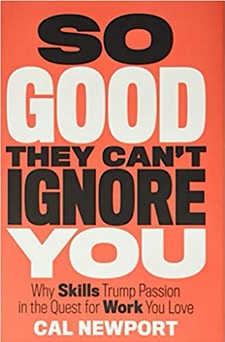
Book Overview: In this eye-opening account, Cal Newport debunks the long-held belief that “follow your passion” is good advice. Not only is the cliché flawed-preexisting passions are rare and have little to do with how most people end up loving their work—but it can also be dangerous, leading to anxiety and chronic job hopping. After making his case against passion, Newport sets out on a quest to discover the reality of how people end up loving what they do. Spending time with organic farmers, venture capitalists, screenwriters, freelance computer programmers, and others who admitted to deriving great satisfaction from their work, Newport uncovers the strategies they used and the pitfalls they avoided in developing their compelling careers. Matching your job to a preexisting passion does not matter, he reveals. Passion comes after you put in the hard work to become excellent at something valuable, not before. In other words, what you do for a living is much less important than how you do it.
Post(s) Inspired by this Book:
“The fish trap exists because of the fish. Once you’ve gotten the fish you can forget the trap. The rabbit snare exists because of the rabbit. Once you’ve gotten the rabbit, you can forget the snare. Words exist because of meaning. Once you’ve gotten the meaning, you can forget the words. Where can I find a man who has forgotten words so I can talk with him?”
Chuang Tzu, via Sunbeams (Page 87)
“To be rational today, we have to do just three things: First, we must look inward. Next, we must examine ourselves critically. Finally, we must make our own decisions—uninhibited by biases or popular notions.”
Ryan Holiday, The Daily Stoic (Page 122)
“If you argue against reality you will suffer.”
Byron Katie | Read Matt’s Blog on this quote ➜
“We are in the habit of imagining our lives to be linear, a long march from birth to death in which we mass our powers, only to surrender them again, all the while slowly losing our youthful beauty. This is a brutal untruth. Life meanders like a path through the woods. We have seasons when we flourish and seasons when the leaves fall from us, revealing our bare bones. Given time, they grow again.”
Katherine May, Wintering
“The teacher learns more than the student. The author learns more than the reader. The speaker learns more than the attendee. The way to learn is by doing.”
James Clear, Blog
“Whenever you are stuck searching for the optimal plan, remember: Getting started changes everything.”
James Clear, Blog
“One can never pay in gratitude; one can only pay ‘in kind’ somewhere else in life.”
Anne Morrow Lindbergh, via Sunbeams (Page 87)
“Love is when I am concerned with your relationship with your own life, rather than with your relationship to mine… There must be a commitment to each other’s well-being. Most people who say they have a commitment don’t; they have an attachment. Commitment means, ‘I am going to stick with you and support your experience of well-being.’ Attachment means, ‘I am stuck without you.'”
Stewart Emery, via Sunbeams (Page 86)
“The afternoon knows what the morning never suspected.”
Swedish proverb, via Sunbeams (Page 86)
“For centuries, people have assumed that wealth would be a wonderful cure-all for their unhappiness or problems. Why else would they have worked so hard for it? But when people actually acquired the money and status they craved, they discovered it wasn’t quite what they had hoped. The same is true of so may things we covet without really thinking.”
Ryan Holiday, The Daily Stoic (Page 122)
“If your comment is helpful to anyone else, than it’s generous indeed. Holding back is selfish, because it deprives the group of your insight at the same time that it normalizes non-participation. If you’re wondering, so is someone else.”
Seth Godin, Blog
“When I pray, I never pray for myself, always for others, or else I hold a silly, naive, or deadly serious dialogue with what is deepest inside me, which for the sake of convenience I call God. Praying to God for something for yourself strikes me as being too childish for words. To pray for another’s well-being is something I find childish as well; one should only pray that another should have enough strength to shoulder his burden. If you do that, you lend him some of your own strength.”
Etty Hillesum, An Interrupted Life, via Sunbeams (Page 85)