“Two kinds of people are good at foreseeing danger: those who have learned at their own expense, and the clever people who learn a great deal at the expense of others.”
Baltasar Gracián, The Pocket Oracle and Art of Prudence


“When I think back to my childhood, I visualize my father, my mother, and Gigi arranged as a philosophical triangle. My father was one side of the triangle: discipline. He taught me how to work, how to be relentless. He instilled in me an ethic that ‘It’s better to die than to quit.’ My mother: education. She believed that knowledge was the irrevocable key to a successful life. She wanted me to study, to learn, to grow, to cultivate a deep and broad understanding, to either ‘know what you’re talking about or be quiet.’ Gigi: love (God). Whereas I tried to please my mother and father so I wouldn’t get into trouble, I wanted to please Gigi so that I could bathe in that transcendent ecstasy of divine love. These three ideas—discipline, education, love—would fight for my attention throughout the rest of my life.”
Will Smith, Will (Page 39)
“For Marcus [Aurelius] philosophy was the therapy of the soul. In this sense, his Meditations are his medications.”
Diskin Clay, via Meditations (pag xxxiii)
“For a philosopher seeking to guide himself repetition is a philosophical virtue. Repetition is a form of spiritual exercise designed to reinforce the main principles of Marcus [Aurelius]’ philosophy; its purpose is to effect a ‘dyeing of the soul.'”
Diskin Clay, via Meditations (pag xviii)
Meditations [Book]
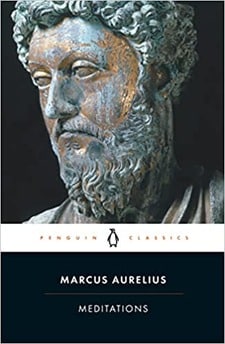
Book Overview: Written in Greek by an intellectual Roman emperor without any intention of publication, the Meditations of Marcus Aurelius offer a wide range of fascinating spiritual reflections and exercises developed as the leader struggled to understand himself and make sense of the universe. Spanning from doubt and despair to conviction and exaltation, they cover such diverse topics as the question of virtue, human rationality, the nature of the gods and the values of leadership. But while the Meditations were composed to provide personal consolation, in developing his beliefs Marcus also created one of the greatest of all works of philosophy: a series of wise and practical aphorisms that have been consulted and admired by statesmen, thinkers and ordinary readers for almost two thousand years.
Will [Book]

Book Overview: Will Smith’s transformation from a West Philadelphia kid to one of the biggest rap stars of his era, and then one of the biggest movie stars in Hollywood history, is an epic tale—but it’s only half the story. Will is the story of how one person mastered his own emotions, written in a way that can help everyone else do the same. Few of us will know the pressure of performing on the world’s biggest stages for the highest of stakes, but we can all understand that the fuel that works for one stage of our journey might have to be changed if we want to make it all the way home. The combination of genuine wisdom of universal value and a life story that is preposterously entertaining, even astonishing, puts Will the book, like its author, in a category by itself.
Post(s) Inspired by this Book:
34 Will Smith Quotes from Will on Hustle, Happiness, and Love


“When I left him, I reasoned thus with myself: I am wiser than this man, for neither of us appears to know anything great and good; but he fancies he knows something, although he knows nothing; whereas I, as I do not know anything, so I do not fancy I do. In this trifling particular, then, I appear to be wiser than he, because I do not fancy I know what I do not know.”
Socrates, via The Daily Laws (Page 373)
The 12 Most Influential Books on MoveMe Quotes in 12 Years of Publishing!

Excerpt: Check out the 12 most influential books that have impacted MoveMe Quotes in over 12 years of quoting, accompanied with the greatest lesson from each!
Read More »The 12 Most Influential Books on MoveMe Quotes in 12 Years of Publishing!


“To the ancient Greeks, far more harm is caused in this world by stupidity and incompetence than outright evil. Those who are overtly evil can be combated, because they are easy to recognize and fight against. The incompetent and stupid are far more dangerous because we are never quite sure where they are leading us, until it is too late. The greatest military disasters in history have more often than not originated from leaders who lack strategic wisdom.”
Robert Greene, The Daily Laws (Page 306)