Skip to content

The Midnight Library [Book]
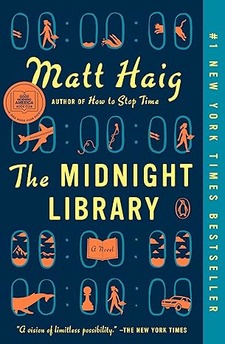
    By: Matt Haig

    Book Overview: Somewhere out beyond the edge of the universe there is a library that contains an infinite number of books, each one the story of another reality. One tells the story of your life as it is, along with another book for the other life you could have lived if you had made a different choice at any point in your life. While we all wonder how our lives might have been, what if you had the chance to go to the library and see for yourself? Would any of these other lives truly be better? In The Midnight Library, Matt Haig’s enchanting blockbuster novel, Nora Seed finds herself faced with this decision. Faced with the possibility of changing her life for a new one, following a different career, undoing old breakups, realizing her dreams of becoming a glaciologist; she must search within herself as she travels through the Midnight Library to decide what is truly fulfilling in life, and what makes it worth living in the first place.
      “There are those who think of the meaning of life as resembling the answer to a riddle. One searches for years, and then some bright day one finds it, like the prize at the end of a treasure hunt. It is a profoundly misleading notion. The meanings in any life are multiple and varied. Some are grasped very early, some late; some have a heavy emotional component, some are strictly intellectual; some merit the label religious, some are better described as social. But each kind of meaning implies a relationship between the person and some larger system of ideas or values, a relationship involving obligations as well as rewards. In the individual life, meaning, purpose and commitment are inseparable. When one succeeds in the search for identity one has found the answer not only to the question ‘Who am I?’ but to a lot of other questions too: ‘What must I live up to? What are my obligations? To what must I commit myself?'”

      John W. Gardner, Self-Renewal (Page 103)

        “I beg you, to have patience with everything unresolved in your heart and to try to love the questions themselves as if they were locked rooms or books written in a very foreign language. Don’t search for the answers, which could not be given to you now, because you would not be able to live them. And the point is to live everything. Live the questions now. Perhaps then, someday far in the future, you will gradually, without even noticing it, live your way into the answer.”

        Rainer Maria Rilke, Letters to a Young Poet

          “The Zen master warns: ‘If you meet the Buddha on the road, kill him!’ This admonition points up that no meaning that comes from outside of ourselves is real. The Buddhahood of each of us has already been obtained. We need only recognize it. Philosophy, religion, patriotism, all are empty idols. The only meaning in our lives is what we each bring to them. Killing the Buddha on the road means destroying the hope that anything outside of ourselves can be our master. No one is any bigger than anyone else. There are no mothers or fathers for grown-ups, only sisters and brothers.”

          Sheldon B. Kopp, If You Meet Buddha On The Road, Kill Him! (Page 188)

            “We must never forget that we may also find meaning in life even when confronted with a hopeless situation, when facing a fate that cannot be changed. For what then matters is to bear witness to the uniquely human potential at its best, which is to transform a personal tragedy into a triumph, to turn one’s predicament into a human achievement. When we are no longer able to change a situation…we are challenged to change ourselves.”

            Viktor Frankl, Man’s Search For Meaning

              “The patient/pilgrim insists that there must be some meaning that he just has not yet gotten hold of or else he would be happy. ‘Why?’ he asks. ‘Why did all this happen to me?’ He believes that if only he could understand, if only the therapist would explain it to him, then he could live with life as it is and be happy. But ‘the meaning of life can be revealed but never explained.’ The point is that there is no point. In a world of billion[s], countless numbers long dead and an infinite number yet to be born, how important are the momentary frustrations or satisfactions of any one of us?”

              Sheldon B. Kopp, If You Meet Buddha On The Road, Kill Him! (Page 41)

                “It’s hard to think about selflessness when we are struggling. And yet that is exactly what I learned as a monk. Selflessness is the surest route to inner peace and a meaningful life. Selflessness heals the self.”

                Jay Shetty, Think Like A Monk (Page 256)

                  “All paralyzed people—psychologically paralyzed, spiritually paralyzed—live life in hell. And how do they create it? The secret is that they live in fear; they only do a certain thing when there is no fear, but then there is nothing left worth doing. All that is worth doing has certain fears around it.”

                  Osho, Everyday Osho (Page 58)

                    “The real question we should ask ourselves is not ‘How big can we get?’ but instead ‘What kind of life do we want to live?’ The magic happens when we shift our focus from size to significance. We might discover that ‘enough’ is a lot less than we thought. Because we’re conditioned to believe that ‘more’ is synonymous with ‘better’. But often, it’s just synonymous with more stress, more time away from family, and more sacrifices.”

                    Justin Welsh

                      “We invent threats to give ourselves a sense of purpose. We imagine obstacles to create a sense of meaning. We start conflicts with others in order to feel necessary.”

                      Mark Manson

                        “There are three strands, present for most everyone: Power (sometimes seen as status, or the appearance of status); Safety (survival and peace of mind); Meaning (hope and the path forward). The changes in our media structure, public health and economy have pushed some people to overdo one or the other and perhaps ignore a third. When a social network finds your button and presses it over and over, it’s hard to resist. New cultural forces catch on because they hit on one or more of these. And politics is understood through this lens as well. See the braid and it’s a lot easier to figure out why we might be stressed.”

                        Seth Godin

                          “It’s sharing our own personal pain that allows us to move beyond it. Because it’s one thing to just sit and intellectualize our problems to ourselves. But once we share and mold that meaning out in the world around us, our pain becomes something outside of us. And because it’s now outside of us, we are finally able to live without it.”

                          Mark Manson, Blog

                            “What are the meaningful struggles in your life? What are the meaningless struggles in your life? What can you do to convert the meaningless struggles into meaningful ones?”

                            Mark Manson