“Healing does not erase the past, and the point of healing is not to forget what has happened. Old memories from hard moments may come up even after deep healing has taken place, but what shifts is how we react to them when they arise. If the intensity of the reaction is decreasing, then real progress is being made. This has nothing to do with suppressing the reaction; it is just a measure of what is actually happening in the mind, It is possible to feel your truth without getting consumed by it or letting it control your behavior.”
Yung Pueblo
“Most people walk the earth unaware that they are not seeing with their eyes. Instead, they are seeing with their emotions, and often these emotions are just the echoes of their past hurts. Many fall into cycles of projection where they are taking their inner roughness and emitting it out into the world. Deep healing and emotional maturity begin when you turn your attention inward. The ability to see yourself as you move through the ups and downs of life, without running away or suppressing your feelings, enhances your understanding…”
Yung Pueblo
“We generally have a volcanic attitude toward our own intrafamily annoyances and frustrations, not expressing them openly until they have grown so strong that it is impossible either to put them sensibly or hold them back. The eruption usually either provokes or occurs during a family squabble, when all parties involved have lost their tempers or are scared stiff. At these times no one listens carefully, and criticisms are exaggerated; we tend to characterize the actions which upset us, not as temporary and reparable failings, but as the products or ingrained vice or genetic debility. Thus expressed, our anger not only fails to correct disorder but rather becomes an injury which prolongs it. To say that we lack self-control is not enough. What we lack is the courage and providence to have expressed ourselves sooner.”
Robert Grudin, Time And The Art Of Living (Page 88)


“The purpose of letting go is not to erase emotions, but to acknowledge their presence and transform your relationship to them. Being able to let go while a tough emotion is passing through helps us be okay with not being okay. Letting go reaches deeper levels when your observation of what is happening inside you is done with total acceptance and when you remember that every part of life is impermanent. Especially in the mind, adding more tension to the tension that is already there will not make things better. When tension is met with unconditional acceptance, it has the space it needs to naturally unfold and release. Unloading and facing the mental weight of past hurt is never easy, but it is possible, especially when you feel ready for a great transformation.”
Yung Pueblo

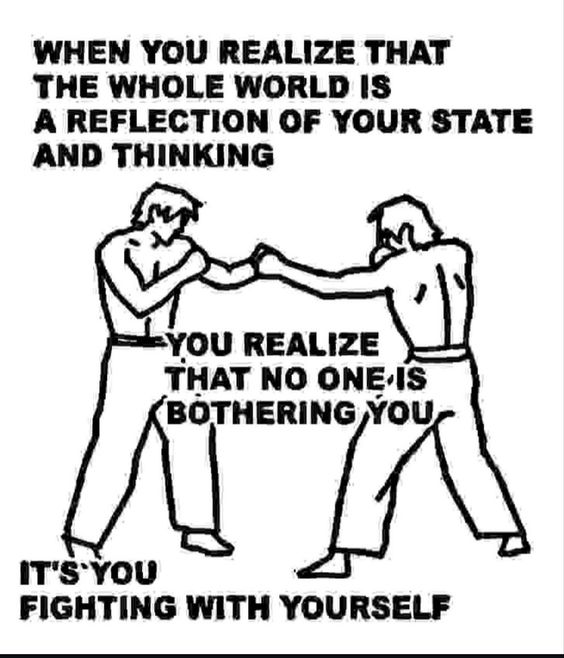
“In Meditations, Marcus [Aurelius] talks about how he had a good day because he escaped anxiety. Then, he actually corrects himself, he goes ‘Actually, no, I didn’t escape it, I discarded it because it was within me.’ He’s realizing that he is the common variable in all the situations that cause him anxiety, just as you are. Anxiety is within us. We want to work on [controlling] it and thinking about it so it doesn’t rule our lives — or ruin our lives.”
Ryan Holiday

“Sadness, anxiety, grief, loss, fear and all other heavy emotions are a normal part of life. Trying to erase them is unrealistic. Instead, your energy is better spent feeling them in a balanced manner. Knowing that there is something in them for you to learn, to process, and to eventually let go. Letting yourself feel the heavy things is not the same as getting stuck in them. Being okay with not being okay is a skill that helps you not get dragged down by challenges.”
Yung Pueblo
“If you are injured and in pain, the path to mental peace can be traversed in a single step: Simply accept the pain as it arises, while doing whatever you need to do to help your body heal. If you are anxious before giving a speech, become willing to feel the anxiety fully, so that it becomes a meaningless pattern of energy in your mind and body. Embracing the contents of consciousness in any moment is a very powerful way of training yourself to respond differently to adversity. However, it is important to distinguish between accepting unpleasant sensations and emotions as a strategy—while covertly hoping that they will go away—and truly accepting them as transitory appearances in consciousness. Only the latter gesture opens the door to wisdom and lasting change. The paradox is that we can become wiser and more compassionate and live more fulfilling lives by refusing to be who we have tended to be in the past. But we must also relax, accepting things as they are in the present, as we strive to change ourselves.”
Sam Harris, Waking Up (Page 149)
“The storm may be powerful, but no storm is endless. Giving space to what you feel is always valuable because it is an essential part of healing and letting go, but if you let it take control then it will be too easy to fall into past patterns. Being with it is better than becoming it. There is a subtle space you should become more familiar with, the space where reclaiming your power is truly possible – the space where you can feel a fire burning within you without giving it more fuel.”
Yung Pueblo