Skip to content

I Don’t Want To Talk About It [Book]

    I Don't Want To Talk About It by Terrence Real

    By:  Terrence Real

    From this Book: 12 Quotes

    Book Overview:  Twenty years of experience treating men and their families has convinced psychotherapist Terrence Real that depression is a silent epidemic in men—that men hide their condition from family, friends, and themselves to avoid the stigma of depression’s “un-manliness.” Problems that we think of as typically male—difficulty with intimacy, workaholism, alcoholism, abusive behavior, and rage—are really attempts to escape depression. And these escape attempts only hurt the people men love and pass their condition on to their children.  This groundbreaking book is the “pathway out of darkness” that these men and their families seek. Real reveals how men can unearth their pain, heal themselves, restore relationships, and break the legacy of abuse.

    Buy from Amazon!  Listen on Audible!

    Not enough time to read entire books? Check out Blinkist and get the key insights from popular nonfiction books in a fraction of the time.  ‘Busy’ isn’t an excuse.

    Post(s) Inspired by this Book:
    1. 25 Quotes on Masculinity, What Can Make It “Toxic,” and How To Break the Cycle of Harm to Our Boys and Men.

      “The unresolved pain of previous generations operates in families like an emotional debt.  We either face it or we leverage our children with it.  When a man stands up to depression, the site of his battle may be inside his own head, but the struggle he wages has repercussions far beyond him.  A man who transforms the internalized voice of contempt resists violence lying close to the heart of patriarchy itself.  Such a man serves as a breakwall.  The waves of pain that may have wreaked havoc across generations spill over him and lose their virulent force—sparing his children.  The ‘difficult repentance’ such a man undertakes protects those who follow him.  And his healing is a spiritual gift to those who came before.  The reclaimed lost boy such a man discovers—the unearthed emotional, creative part of him—may not be merely the child of his own youth, but the lost child of his father’s youth, or even of his father’s father.”  ~ Terrence Real, I Don’t Want To Talk About It

        “Boys don’t hunger for fathers who will model traditional mores of masculinity.  They hunger for fathers who will rescue them from it.  They need fathers who have themselves emerged from the gauntlet of their own socialization with some degree of emotional intactness.  Sons don’t want their father’s ‘balls’; they want their hearts.  And, for many, the heart of a father is a difficult item to come by.” ~ Terrence Real, I Don’t Want To Talk About It

          “The key component of a boy’s healthy relationship to his father is affection, not ‘masculinity.’  The boys who fare poorly in their psychological adjustment are not those without fathers, but those with abusive or neglectful fathers. Contrary to the traditional stereotype, a sweet man in an apron who helps out with the housework may be just the nurturant kind of father a boy most needs.” ~ Terrence Real, I Don’t Want To Talk About It

            “As with intelligence, so too with behaviors—malleable kids live up, or down, to our expectations.” ~ Terrence Real, I Don’t Want To Talk About It

              “I think not touching a child for decades at a time is a form of injury.  I think withholding any expression of love until a young boy is a grown man is a form of emotional violence.  And I believe that the violence men level against themselves and others is bred from just such circumstances.” ~ Terrence Real, I Don’t Want To Talk About It

                “If you have difficulties with your son or daughter, you may have the tendency to say: “You are not my daughter.  My daughter would not behave like that” or “You are not my son.  My son would never do things like that.”  If you look deeply at yourself, you will see that these negative seeds are in you also.  When you were young you made mistakes and you learned from your suffering.  When your child makes mistakes, you need to help him understand so he will not do it again.  When you can see your own weaknesses, you can say: “Who am I not to accept my son?” Your son is you.  With this insight into non-duality, you can reconcile with your children.” ~ Thich Nhat Hanh, No Death, No Fear

                  “I know many parents whose children, when they are eighteen or nineteen years old, leave home and live on their own.  The parents lose their children and feel very sorry for themselves.  Yet the parents did not value the moments they had with their children.  The same is true of husbands and wives.  You think that your spouse will be there for the whole of your life, but how can you be so sure?  We really have no idea where our partners will be in twenty or thirty years’ time or even tomorrow.  It is very important to remember every day the practice of impermanence.” ~ Thich Nhat Hanh, No Death, No Fear

                    “The child wants to go out while it is raining and wants to dance in the rain: ‘No! You will get a cold.’  A cold is not a cancer, but a child who has been prevented from dancing in the rain, and has never been able again to dance, has missed something great, something really beautiful.  A cold would have been worthwhile—and it is not that he will necessarily have a cold.  In fact, the more you protect him, the more he becomes vulnerable.  The more you allow him, the more he becomes immune.” ~ Osho, Fame, Fortune, and Ambition

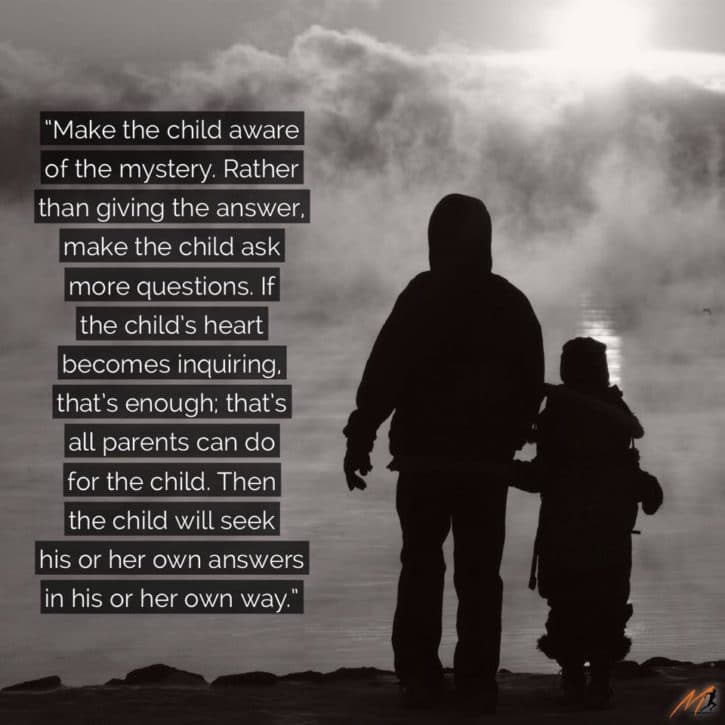
                      “Make the child aware of the mystery.  Rather than giving the answer it is better to make the child aware of the mysterious that’s all around, so the child starts feeling more awe and more wonder.  Rather than giving a pat answer it is better to create an inquiry.  Help the child to be more curious, help the child to be more inquiring.  Rather than giving the answer, make the child ask more questions.  If the child’s heart becomes inquiring, that’s enough; that’s all parents can do for the child.  Then the child will seek his or her own answers in his or her own way.” ~ Osho, The Art of Living and Dying

                        “If you were a role model to millions of children who closely followed you and your life choices, how would you change your behavior? …What if only your own kids were noticing you and being affected?” ~ Gregory Stock, The Book of Questions