“Outward transformation—in our clothes, in our cars, in our grooming—might feel important but is superficial compared with the inward change.”
Ryan Holiday, The Daily Stoic (Page 249)
“The way to set moral change in motion, [Anthony Appiah] says, is not to go for the jugular, or even for dialogue—straight to the things that divide you. Talk about sports. Talk about the weather. Talk about your children. Make a human connection. Change comes about in part, as he describes it, by way of ‘conversation in the old-fashioned sense’—simple association, habits of coexistence, seeking familiarity around mundane human qualities of who we are.”
Krista Tippett, Becoming Wise (Page 135)

“We heal when we feel forgiven. We heal in the presence of compassion. If you really want someone to change, the miracle lies in your ability to see how perfect they already are.”
Marianne Williamson, The Shadow Effect (Page 175)
“Just because you’ve begun down one path doesn’t mean you’re committed to it forever, especially if that path turns out to be flawed or impeded. At that same time, this is not an excuse to be flighty or incessantly noncommittal. It takes courage to decide to do things differently and to make a change, as well as discipline and awareness to know that the notion of ‘Oh, but this looks even better’ is a temptation that cannot be endlessly indulged either.”
Ryan Holiday, The Daily Stoic (Page 172)
Happy But Never Satisfied – Motivational or Misleading?

Excerpt: Many people love the phrase “Be happy, but never satisfied” and they find it motivational. But, what if it was actually misleading and dangerous for our mental framework?
Read More »Happy But Never Satisfied – Motivational or Misleading?
“…we die to each other daily.
What we know of other people
Is only our memory of the moments
During which we knew them. And they have changed since then.
To pretend that they and we are the same
Is a useful and convenient social convention
which must sometimes be broken. We must also remember
That at every meeting we are meeting a stranger.”
T.S. Eliot, The Cocktail Party, via Sunbeams (Page 74)
“Idealistic reformers are dangerous because their idealism has no roots in love, but is simply a hysterical and unbalanced rage for order amidst their own chaos.”
William Irwin Thompson, via Sunbeams (Page 67)
“Do you change people first or do you change society? I believe this is a false dichotomy. You have to change both simultaneously. If you’re changing only yourself and have no concern for changing the society, something goes awry. If you’re changing only society but not changing yourself, something goes awry, as tended to happen in the late 1960s. Now, ‘simultaneously’ may be an overstatement, because I think there are periods when one has to concentrate on one or the other. And there are periods in a society, in a culture, when the emphasis is appropriate only on one or the other. What I’m trying to say is, never lose sight of either the internal world or the external world, the peace within and the peace based on justice on the outside.”
David Dellinger, via Sunbeams (Page 66)
10 Stephen Grosz Quotes From The Examined Life on Pain, Change, and Loss
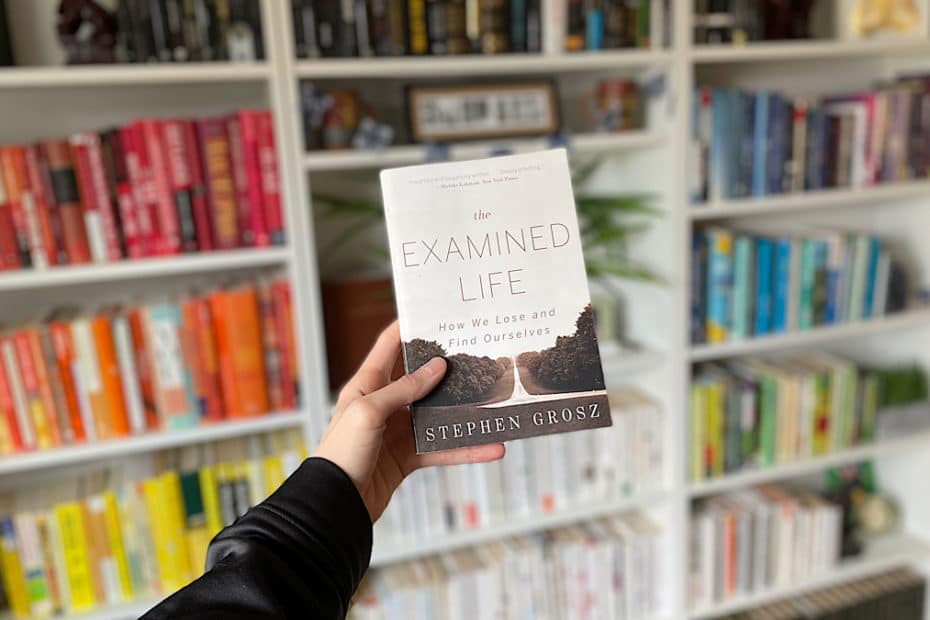
Excerpt: Stephen Grosz has been a psychoanalyst for 25+ years. These quotes from The Examined Life give you access to 50,000+ hours of his distilled insight.
Read More »10 Stephen Grosz Quotes From The Examined Life on Pain, Change, and Loss
“We are vehemently faithful to our own view of the world, our story. We want to know what new story we’re stepping into before we exit the old one. We don’t want an exit if we don’t know exactly where it is going to take us, even—or perhaps especially—in an emergency. This is so, I hasten to add, whether we are patients or psychoanalysts.”
Stephen Grosz, The Examined Life (Page 123)
“Change and loss are deeply connected—there cannot be change without loss.”
Stephen Grosz, The Examined Life (Page xii)