
Archives
“Try to imagine a life without timekeeping. You probably can’t. You know the month, the year, the day of the week. There is a clock on your wall or the dashboard of your car. You have a schedule, a calendar, a time for dinner or a movie. Yet all around you, timekeeping is ignored. Birds are not late. A dog does not check its watch. Deer do not fret over passing birthdays. Man alone measures time. Man alone chimes the hour. And, because of this, man alone suffers a paralyzing fear that no other creature endures. A fear of time running out.”
Mitch Albom
“There are those who think of the meaning of life as resembling the answer to a riddle. One searches for years, and then some bright day one finds it, like the prize at the end of a treasure hunt. It is a profoundly misleading notion. The meanings in any life are multiple and varied. Some are grasped very early, some late; some have a heavy emotional component, some are strictly intellectual; some merit the label religious, some are better described as social. But each kind of meaning implies a relationship between the person and some larger system of ideas or values, a relationship involving obligations as well as rewards. In the individual life, meaning, purpose and commitment are inseparable. When one succeeds in the search for identity one has found the answer not only to the question ‘Who am I?’ but to a lot of other questions too: ‘What must I live up to? What are my obligations? To what must I commit myself?'”
John W. Gardner, Self-Renewal (Page 103)
“We pretend that so many courses, so many credits, so many hours in a classroom, so many books read add up to an education. The same is true of research, on which we now spend billions of dollars annually. We seem immensely satisfied with the outer husk of the enterprise—the number of dollars spent, the size of laboratories, the number of people involved, the fine projects outlined, the number of publications. Why do we grasp so desperately at externals? Partly because we are more superficial than we would like to admit. Perhaps partly because we are too lazy or too preoccupied to go to the heart of the problem. But also because it is easier to organize the external aspects of things. The mercurial spirit of great teaching and great scholarship cannot be organized, rationalized, delegated or processed. The formalities and externals can.”
John W. Gardner, Self-Renewal (Page 82)
“Every top executive and every analyst sitting at the center of a communications network should periodically emerge from his world of abstractions and take a long unflinching look at unprocessed reality. Every general should spend some time at the front lines; every research administrator should spend some time in the laboratory doing research of his own; every sales manager should take his sample case out periodically and call on customers; every politician should get out and ring doorbells.”
John W. Gardner, Self-Renewal (Page 79)
“Nothing is more vital to the renewal of an organization (or society) than the system by which able people are nurtured and moved into positions where they can make their contribution. In an organization this implies effective recruitment and a concern for the growth of the individual that extends from the earliest training stages through the later phases of executive development. For a society it implies the correction of social and economic conditions that blight and smother talent in childhood; a deeply rooted tradition—going far beyond formal schooling—of the full development of individual potentialities; and the existence of social mobility such that talent from any segment of the population may move freely into significant roles in the society.”
John W. Gardner, Self-Renewal (Page 76)




26 J. Krishnamurti Quotes from Freedom From The Known For A More Liberated, “First-Hand” Life Experience
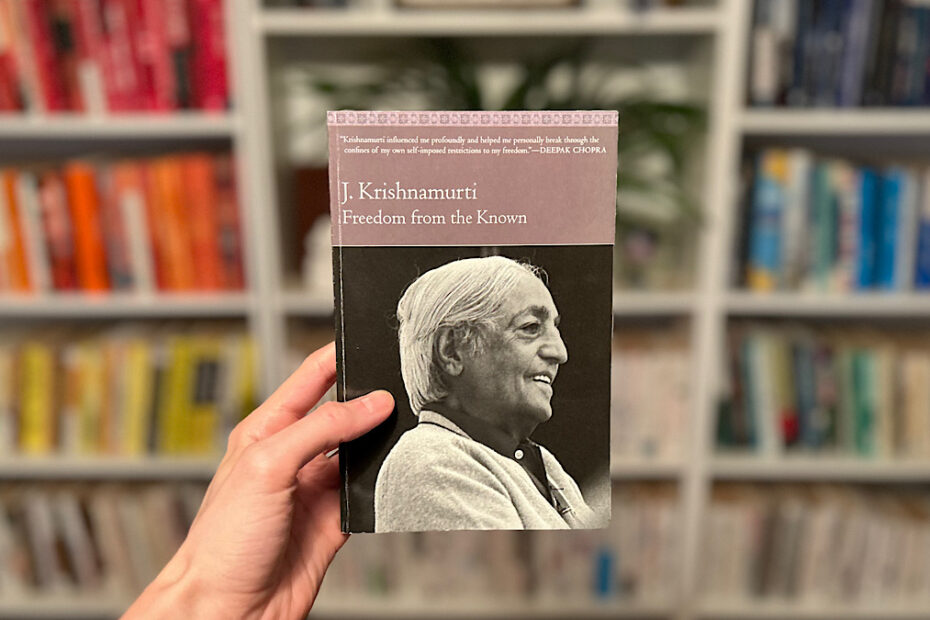
Excerpt: This collection of J. Krishnamurti quotes will challenge you and your beliefs, give you fresh perspectives, and leave you feeling liberated…
Read More »26 J. Krishnamurti Quotes from Freedom From The Known For A More Liberated, “First-Hand” Life Experience
“The ever-renewing organization (or society) is not one which is convinced that it enjoys eternal youth. It knows that it is forever growing old and must do something about it. It knows that it is always producing deadwood and must, for that reason, attend to its seedbeds. The seedlings are new ideas, new ways of doing things, new approaches. If all innovations must pass before one central decision point, they have just one chance to survive and a slim one at that. In an organization with many points of initiative and decision, an innovation stands a better chance of survival; it may be rejected by nine out of ten decision makers and accepted by the tenth. if it then proves its worth, the nine may adopt it later.”
John W. Gardner, Self-Renewal (Page 68)
“Specialization is biologically, socially and intellectually necessary. The highest reaches of education will always involve learning one thing in great depth. The great artist or scientist often achieves the heights of performance through intensive cultivation of a narrow sector of his potentialities.”
John W. Gardner, Self-Renewal (Page 24)

“Stoicism is not just invulnerability…if such a thing even exists. Stoicism is also having the self-awareness to know when you are struggling. It’s having the courage to admit when you could use a hand. It’s having the wisdom not to pretend you know the answer (you can’t learn that which you think you already know, Epictetus says). It takes daring and toughness to go to therapy—perhaps more than just white knuckling it. It’s a brave thing to share your struggles with a friend or to hire a coach or expert to help you get better at something. It takes a confident person to ask a question or admit, ‘I don’t know.’ Don’t be like the cowards who are too fragile or fearful to do this. Be truly courageous.”
Ryan Holiday
“I think of beauty as an absolute necessity. I don’t think it’s a privilege or an indulgence, it’s not even a quest. I think it’s almost like knowledge, which is to say, it’s what we were born for. I think finding, incorporating and then representing beauty is what humans do. With or without authorities telling us what it is, I think it would exist in any case. The startle and the wonder of being in this place. This overwhelming beauty—some of it is natural, some of it is man-made, some of it is casual, some of it is a mere glance—is an absolute necessity. I don’t think we can do without it any more than we can do without dreams or oxygen.”
Toni Morrison
“All too often we are giving our young people cut flowers when we should be teaching them to grow their own plants. We are stuffing their heads with the products of earlier innovation rather than teaching them to innovate. We think of the mind as a storehouse to be filled when we should be thinking of it as an instrument to be used.”
John W. Gardner, Self-Renewal (Page 21)